Foraminal Stenosis Treatment in Tampa, Florida
Foraminal Stenosis: Causes, Symptoms, and Endoscopic Treatment
The foraminal canals are small openings on either side of each vertebra through which spinal nerve roots exit the spinal column and travel to the rest of the body. When these openings become narrowed, a condition known as foraminal stenosis, the nerve root is compressed, producing pain, tingling, numbness, or weakness that can radiate into the arms or legs depending on where in the spine the compression occurs. It is a precise, localized problem that calls for a precise, localized solution.
At 360 Ortho & Spine in Tampa, Florida, Dr. Stefan Prada is a board-certified orthopedic spine surgeon who treats foraminal stenosis using endoscopic foraminotomy, a minimally invasive procedure that widens the affected foraminal opening and frees the compressed nerve root without metal implants, without fusion, and without the muscle damage that traditional open surgery requires. Most patients return to normal activity in approximately six weeks.
If you've been diagnosed with foraminal stenosis or are experiencing radiating nerve pain that hasn't responded to conservative treatment, request a consultation at 360 Ortho & Spine today.

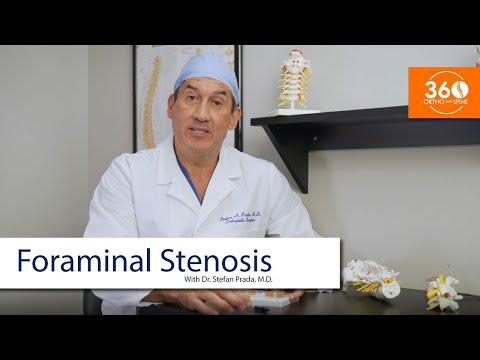
What Is Foraminal Stenosis? Causes and Symptoms
Understanding Foraminal Stenosis and Its Treatment
Foraminal stenosis describes a narrowing of the foraminal canals, the passages through which nerve roots branch off from the spinal cord and travel to the limbs and extremities. This narrowing reduces the space available for the nerve root, and when the nerve is compressed, the results can include pain that radiates far from the actual site of the problem.
What Causes Foraminal Stenosis?
The most common causes include herniated disc material that bulges into the foraminal canal, bone spurs that grow into the opening, thickened spinal ligaments, and disc height loss from degenerative disc disease that allows the vertebrae to shift closer together, reducing the foraminal space. These causes can appear in the cervical spine of the neck or the lumbar spine of the lower back.
Foraminal Stenosis Symptoms
Foraminal stenosis symptoms are determined by which nerve root is being compressed and at which spinal level. Cervical foraminal stenosis commonly causes pain, tingling, or weakness that radiates into the shoulder, arm, or hand. Lumbar foraminal stenosis produces similar symptoms in the hip, leg, or foot. In both cases, symptoms may worsen with certain positions or activities and improve temporarily with others.
Foraminal Stenosis Treatment at 360 Ortho & Spine
Dr. Prada treats foraminal stenosis using:
- Endoscopic Foraminotomy: Removes the tissue, bone, or disc material narrowing the foraminal opening, restoring space for the nerve root without metal implants or fusion
This procedure is performed through a small incision under endoscopic guidance. The surrounding muscle tissue is preserved, recovery is typically completed in approximately six weeks, and no hardware is placed in the spine. Endoscopic foraminotomy is part of 360 Ortho & Spine's broader approach to spinal decompression surgery. During your consultation, Dr. Prada will confirm whether foraminal stenosis is the source of your symptoms and which endoscopic approach is most appropriate for your specific case.
Frequently Asked Questions
What is foraminal stenosis?
Foraminal stenosis is a narrowing of the foraminal canals, the small passages on either side of each vertebra through which nerve roots exit the spinal column. When these openings are narrowed by a herniated disc, bone spur, or other tissue, the nerve root is compressed, causing pain, tingling, numbness, or weakness that typically radiates into the arms or legs depending on which spinal level is affected.
What are the symptoms of foraminal stenosis?
Foraminal stenosis causes symptoms along the path of the compressed nerve root. Cervical foraminal stenosis typically produces radiating pain, tingling, or weakness in the shoulder, arm, or hand. Lumbar foraminal stenosis causes similar symptoms in the hip, leg, or foot. Localized neck or back pain at the affected spinal level is also common. Symptoms often worsen with certain positions and may improve temporarily with others.
Is surgery the only option for foraminal stenosis?
Surgery is not always the first step. Many patients with foraminal stenosis find partial or temporary relief through physical therapy, anti-inflammatory medication, or steroid injections. When these conservative options have been exhausted and symptoms are persistent or worsening, surgical treatment with endoscopic foraminotomy can provide lasting relief by addressing the structural cause of the nerve compression directly.
How do I find an orthopedic spine surgeon near me for foraminal stenosis?
Finding an orthopedic spine surgeon near you who specializes in endoscopic foraminotomy without metal implants can be challenging. Scheduling with Dr. Prada at 360 Ortho & Spine in Tampa, Florida, is simple: request a consultation online or call our office, and our team will follow up to help you plan your visit. We look forward to helping you find relief.