Herniated Disc Treatment in Tampa, Florida
Herniated Disc: Expert Treatment Without Metal Implants
A herniated disc is one of the most common causes of significant back and neck pain, and for many patients, also one of the most treatable. The disc sits between the vertebrae of the spine and acts as a shock absorber. When its tough outer layer cracks and the soft inner material pushes through, it can press against the spinal cord or a nearby nerve root, triggering pain that may radiate from the neck into the arms or from the lower back into the legs. Also commonly called a slipped disc or ruptured disc, the condition can develop gradually over time or suddenly following a strain or injury.
At 360 Ortho & Spine in Tampa, Florida, Dr. Stefan Prada is a board-certified orthopedic spine surgeon who treats herniated discs using minimally invasive endoscopic procedures. With over 11,000 procedures performed, Dr. Prada addresses the structural source of disc-related pain without metal implants, without fusion, and with a recovery that most patients complete in approximately six weeks. His approach is designed for patients who are ready to address the problem rather than manage it indefinitely.
If a herniated disc is causing your symptoms, don't put off finding a real solution. Request a consultation at 360 Ortho & Spine today.
Understanding Herniated Disc Causes, Symptoms, and Treatment
What to Know About Herniated Disc Treatment
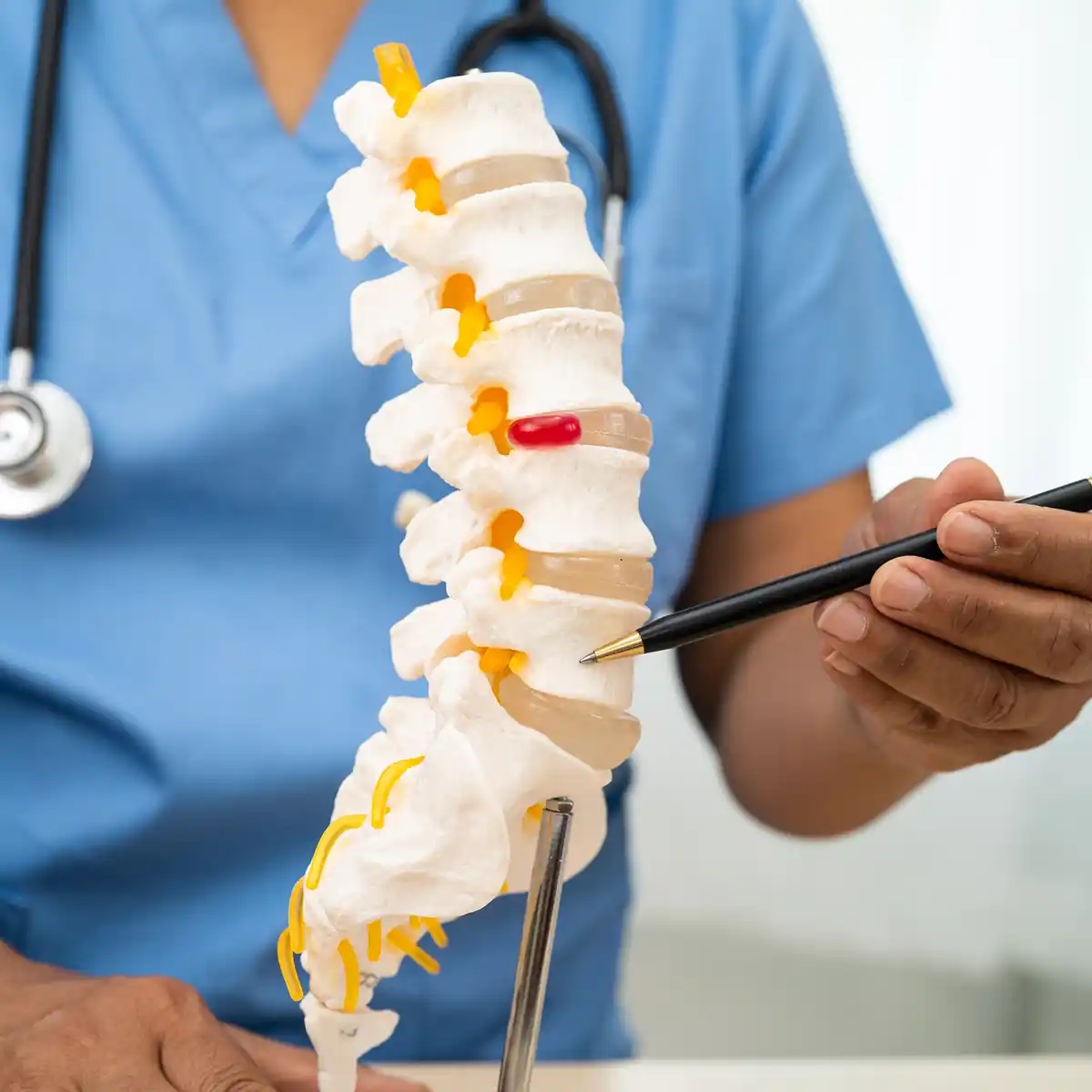
A herniated disc occurs when the nucleus pulposus, the soft, gel-like center of a spinal disc, pushes through a tear in the annulus fibrosus, the tough outer layer. This displacement can press against the spinal cord or a spinal nerve root, and the resulting nerve irritation is responsible for most of the pain, tingling, and weakness that patients experience.
What Causes a Herniated Disc?
Disc herniation most commonly results from gradual, age-related degeneration. As discs lose hydration and become less flexible, they grow more vulnerable to cracking under everyday stress. Sudden trauma, such as lifting a heavy object with poor mechanics, can also cause a disc to herniate acutely. Risk factors include genetics, obesity, smoking, and occupations that involve repetitive bending or lifting. Herniated discs most commonly occur in the lumbar spine but are also frequent in the cervical spine.
Herniated Disc Symptoms
Herniated disc symptoms depend on which disc is affected and whether it is pressing on a nerve. Not all herniated discs cause symptoms. When they do, patients may experience localized back or neck pain at the site of the herniation, along with radiating pain, tingling, numbness, or weakness in the arms or legs. Lumbar disc herniation frequently causes sciatica, a condition in which pain travels from the lower back through the hip and down the leg.
Herniated Disc Treatment at 360 Ortho & Spine
For patients whose symptoms have not improved with conservative care, Dr. Prada offers:
- Endoscopic Discectomy: Removes the herniated portion of the disc pressing on the nerve, without metal implants or fusion
- Spinal Decompression Surgery : Relieves nerve compression through endoscopic techniques depending on the location and nature of the herniation
- Endoscopic Laminotomy: Creates space within the spinal canal when the herniated disc contributes to canal narrowing
- Endoscopic Foraminotomy: Widens the foraminal opening when a herniated disc is compressing a nerve root at its exit point
All procedures are performed through a small incision, preserve surrounding muscle tissue, and require no metal implants. Most patients return to normal activity in approximately six weeks.
Frequently Asked Questions
What are the symptoms of a herniated disc?
Herniated disc symptoms vary depending on the location of the affected disc and whether disc material is pressing on a nerve. Common symptoms include localized back or neck pain, stiffness, and muscle spasm. When a nerve is compressed, patients typically experience radiating pain, tingling, numbness, or weakness that travels into the arm or leg on the side of the compression. In lumbar herniations, this often presents as sciatica.
What is the difference between a herniated disc and a slipped disc?
The terms herniated disc, slipped disc, and ruptured disc all refer to the same condition: a disc whose inner nucleus has pushed through a crack in the outer layer. None of the terms is technically precise, but they all describe the same underlying structural problem. At 360 Ortho & Spine, Dr. Prada treats all forms of disc herniation using endoscopic techniques without metal implants.
When is surgery recommended for a herniated disc?
Surgical treatment for a herniated disc is typically considered after conservative measures, such as physical therapy, anti-inflammatory medication, and steroid injections, have failed to provide lasting relief. It becomes more urgent when patients experience progressive neurological symptoms such as increasing weakness or numbness. During your consultation, Dr. Prada will review your imaging and determine whether endoscopic surgery is the appropriate next step.
How do I find a herniated disc specialist near me?
Finding a herniated disc specialist near you who performs minimally invasive endoscopic procedures without metal implants can be difficult. Scheduling with Dr. Prada at 360 Ortho & Spine in Tampa, Florida, is simple: request a consultation online or call our office directly, and our team will follow up to help plan your visit. We look forward to helping you find the relief you've been searching for.